








Showing posts with label Marriage Monday. Show all posts

Thursday, August 19, 2010

Thriving Despite a Difficult Marriage

I see so many couples in marriage counseling that come to me at the end of their marital rope...they feel desperate and wonder if their marriages can be saved or if it is too late for them. I have always believed that no marriage is so far gone that it can't be helped...if both partners are willing to work. But what about those relationships where only one partner is willing to work on the relationship? Or those marriages where one partner doesn't believe their is a problem and is unwilling to engage in even a conversation about what needs to change? What is a Christian to do when they feel that divorce is not an option, but remaining in an unhealthy marriage seems like a life sentence? As a marriage counselor I have not always had an answer to that question. It seems like divorce would be the most humane way to end the misery of an unhealthy marriage...but there has to be another way!

On the recommendation of a client
I have been reading the book Thriving Despite a Difficult Marriage by Michael Misja. Ph.D. and Chuck Misja, Ph.D. The authors believe that you can thrive even when faced with a partner who is unwilling or unable to change. Unfortunately, there is a lot working against marriage today. Our society would have us believe that everything is disposable...even marriage. If you're not "happy" you have the right to go find "happiness" even if it means leaving your spouse. Another force working against marriage is found in Ephesians 6:12 "For our struggle is not against flesh and blood, but against the rulers, against the authorities, against the powers of this dark world and against the spiritual forces of evil in the heavenly realms." The authors of Thriving Despite a Difficult Marriage state, "Your and your spouse's hearts are precious to God. The Enemy knows this and will spare nothing and no one in his attempts to conquer your heart. If he can give you a spiritual cancer by producing despair, bitterness, pride, or apathy, he has won your heart," and "You are on the right path when you understand that the true problem that needs to be addressed doesn't concern the defects in your spouse but rather the darkness that emerges from your own heart while in a difficult marriage."

Thriving in a difficult marriage means facing the truth about marriage...that it is hard, and it takes work. If you are looking for a book that sugar coats the truth about marriage this is not the book for you...but if you are ready to let God work in you and subsequently your marriage you might want to pick this one up!

Monday, January 11, 2010

Monday, October 26, 2009

Marriage Monday


How Well Do You Know Your Partner?

One of the most important features of successful couple relationships is the quality of the friendship. Do you know your partner's inner world? Take the quiz below and find out.


1. I can name my partner's best friends. yes no
2. I know what stresses my partner is currently facing. yes no
3. I know the names of some of the people who have been irritating my partner lately. yes no
4. I can tell you some of my partner's life dreams. yes no
5. I can tell you about my partner's basic philosophy of life. yes no
6. I can list the relatives my partner likes the least. yes no
7. I feel that my partner knows me pretty well. yes no
8. When we are apart, I often think fondly of my partner. yes no
9. I often touch or kiss my partner affectionately. yes no
10. My partner really respects me. yes no
11. There is fire and passion in this relationship. yes no
12. Romance is definitely still part of our relationship. yes no
13. My partner appreciates the things I do in this relationship. yes no
14. My partner generally likes my personality. yes no
15. Our sex life is mostly satisfying. yes no
16. At the end of the day my partner is glad to see me. yes no
17. My partner is one of my best friends. yes no
18. We just love talking to each other. yes no
19. There is lots of give and take (both people have influence) in our discussions. yes no
20. My partner listens respectfully, even when we disagree. yes no
21. My partner is usually a great help as a problem solver. yes no
22. We generally mesh well on basic values and goals in life. yes no


Your score:
15 or more yes answers: You have a lot of strength in your relationship. Congratulations!


8 to 14: This is a pivotal time in your relationship. There are many strengths you can build upon but there are also some weaknesses that need your attention.


7 or fewer: Your relationship may be in serious trouble. If this concerns you, you probably still value the relationship enough to try to get help.


This quiz highlights elements of what Dr. Gottman refers to as your "love map." In his workshops, Dr. Gottman discusses the step-by-step process of making sure that you nurture your friendship with your partner. In a survey of 200 couples attending a weekend workshop, Dr. Gottman found that the best predictor of passion and romance in a relationship was...you guessed it...the quality of the friendship!
Check out http://www.gottman.com for more information about marriage.

Monday, March 16, 2009

Marriage Monday


Last month we celebrated our 35th anniversary. I wish I could say that after 35 years we had arrived at "marital bliss", but I can't. What I can say is that the lessons I have learned in the last 35 years could not have been learned any other way. I have realized that God allows us to be in relationships that are sometimes "irritating" to sharpen and refine us. Proverbs 27:17 says, "As iron sharpens iron, so one man sharpens another." Have you ever pictured iron sharpening iron? Sparks fly as the two pieces of metal collide. But it is through the collision and the heat that the sharpening takes place.

Most of us grew up believing the ending to most fairy tales, "They got married and lived happily ever after." And most of us who have been married for a while have probably been disappointed that it really isn't that easy. So, what do we do when the sparks fly? And trust me, they will! Here are some tips for how to handle conflict in marriage...some of them that I have learned in 35 years, and some that I'm still trying to master!

  • Face your fear of confrontation. I hate confrontation...but my husband loves to get things resolved. I learned pretty early in our marriage that our fights could last 5 minutes or 5 hours...and it all depended on me. If I tried to avoid confrontation my husband would keep going until the situation was addressed. If I got in there and "fought it out" the confrontation was usually over in 5 minutes!
  • Focus on the behavior, not the person. Say, "could you please put your dishes in the dishwasher", not "You're such a slob!"
  • Stay on topic. Our fights in marriage usually follow the same themes...but be careful not to bring up past hurts or failures, even if they are similar to what is frustrating you right now.
  • Be assertive (and respectful). Assertiveness is found in the balance between passive and aggressive. Aggressive says, "I only care about me, so I'm going to walk all over you, and if you don't like it, too bad." Passive says, "I only care about you, so you can walk all over me and I won't say anything." Assertive says, "I care about you, AND I care about me, so I won't do anything to intentionally hurt you, but I also won't let you do anything to intentionally hurt me."
  • Really listen to your spouse. Most of us know what we are trying to say, and sometimes it just doesn't come out right. Our spouses are no different. There are times when my husband says something that I perceive as mean. I have to really listen to what he is trying to say, and sometimes say "If you just said what I think you said that hurt." This gives him the opportunity to restate what he meant...not what I heard!

Living happily ever after takes a lot of work...but it is worth the effort!

Monday, May 12, 2008

Marriage Monday


Communication


Have you ever felt like you and your spouse have a hard time communicating with each other? Like everything you say is taken the wrong way, or your spouse just doesn't understand your feelings? Communication is difficult at times because we communicate with more than just words. Research shows that more than 70 percent of communication is nonverbal. If a message is misunderstood, it may be because of the nonverbal messages that are being sent through your tone of voice, hand gestures, facial expressions, eye contact or posture.

At times our nonverbal messages contradict the words we say, and may actually more accurately convey how we REALLY feel and think. So, how can we learn to communicate effectively?

1. Become aware of your own thoughts and feelings
2. Share those feelings in a caring, respectful way by stating what you feel without blaming
3. Focus on your spouse - try to imagine how they might feel about what is being said
4. Look for nonverbals - notice what is not being said but may be communicated through your spouses body language
5. Think before you speak - filter your words by asking yourself "how will my partner feel if I say these words."
6. Express appreciation - A simple thank you can make your spouse feel valued and appreciated.
7. Practice forgiveness - we all blow it sometimes and say things we shouldn't. Try to be the first one to apologize and the first to forgive...it will be reciprocated!

Monday, April 7, 2008

Marriage Monday: Expectations Quiz

Do You Expect Too Much?
RESPONSE SCALE

0 = Don't know 1 = Strongly disagree 2 = Disagree 3 = Agree 4 = Strongly agree

_______ 1. My partner can and will meet all of my needs.
_______2. Our current problems can all be resolved by spending more time together.
_______ 3. If we commit to it, I believe my mate and I can overcome any problem or struggle.
_______ 4. My partner and I want exactly the same things from our marriage.
_______ 5. With mutual willingness to teach and learn, our sex life will get better with each passing year.
_______ 6. I believe I will always feel in love with my mate.
_______ 7. My partner and I fully understand each other.
_______ 8. My mate can and should be my best friend.
_______ 9. I expect romantic feelings in our marriage to come and go, largely controlled by our own actions.
_______ 10. My partner is everything I've ever dreamed a spouse should be.
_______ 11. I don't believe there will ever be any serious problems in our relationship.
_______ 12. My partner and I have resolved all the issues from our pasts that could affect our relationship.
_______ 13. I believe marriage is a gift from God and that overall it will be a very enjoyable experience.
_______ 14. I believe our sexual relationship will always be wonderful and free from conflict.
_______ 15. Being involved in a church will keep us from having serious marital struggles.

Total Score _______

WHAT YOUR SCORE MEANS

0-30 You're wearing dark glasses. Either your view of marriage is somewhat negative, or you are uncertain on a number of marital issues. Seek counsel from a pastor or a wise, older friend who has a healthy, fun marriage.

31-40 Your glasses are clear. You have a fairly realistic expectation of marriage. But seek outside input regarding any areas in which you answered "don't know."

41-50 Your glasses have a rose tint to them. You are very optimistic about marriage, but tend to minimize problems and differences. Find a mentor who will bring realism yet not destroy your excitement.

51-60 Your glasses are completely rose colored. You are heading toward a major relationship crisis due to failed expectations.

Monday, February 18, 2008

Marriage Monday

Every family has a personality. I'm sure you have seen it. Some families love each other deeply but fight all the time. Others are quiet, stoic, and seldom express emotons. Some are touchy/feely - they hug and kiss at every meeting and parting. Others slap each other on the back or shake hands but would never think of kissing their relatives.


The family that we grow up in has a profound effect on our expectations of family life. We walk into marriage expecting our newly formed family to operate the way our family of origin did, and we are often shocked to learn that our new spouse has their own, different, expectations!

That is when the "fun" begins! Bringing two individuals with different expectations together to form their own, unique, family personality. So, what does a couple do when they find that their expectations collide? Taking time to look at how your individual families of origin operated and what you and your spouse learned about life from them will help you begin to understand that your spouse does not do the things they do to drive you crazy! And different does not equal wrong!

Here are some topics to talk about:

How Christmas is celebrated
Who pays the bills
How birthdays are celebrated
How money is spent
How chores are divided
How conflicts are resolved
Who makes the final decisions

Monday, February 4, 2008

Marriage Monday

When we get married we repeat our vows...really meaning them, but not really understanding the implications of the words we repeat. A great exercise for a couple to do is to take the words from our vows and think about what they mean. Set aside some time to go through these individually and then with your spouse. Write each phrase at the top of a separate piece of paper and write how your marriage has lived up to the vows you made on your wedding day:


To have and to hold
From this day forward
For better, for worse
For richer, for poorer
In sickness and in health
To love and to cherish

Once you are each finished take some time to share your thoughts with your partner.

Monday, January 28, 2008

Marriage Monday

There was some interesting research this week about how spouses who fight live longer. John Gottman, a leading marriage researcher, has classified what he calls "master couples." A master couple is a couple who has stayed married and still kind of like each other. He says that couples who are "masters" don't fight less than other couples, but they have learned how to repair their fights and how to exit fights. Check out Gottman's book Seven Principles for Making Marriage Work to read more about successful couples.


Monday, January 21, 2008

Marriage Monday


I was reading some information today about The National Marriage Project at Rutgers University. One of their publications, The Top Ten Myths of Marriage, discusses the myth that couples who live together before marriage really get to know each other better and have longer lasting marriages because they are so well suited for each other.

I have found, in almost 34 years of marriage, that marriage is more about commitment than feeling, and more about the decision to accept my spouse than my skill in finding someone who suits me well. My picture of the difference between living together and being married is like the difference between renting an apartment and buying a house. When I was newly married we rented an apartment. In some ways it was great…no maintenance, no lawn mowing, no long term commitment. If something broke all I had to do was call the landlord. There was a down side to being a renter however. I couldn’t paint the walls in my apartment, I didn’t get the benefit of mortgage tax deductions, I had to wait, sometimes for weeks, for the landlord to fix things.

When couples chose to live together before marriage they are like renters. They want the benefits without the commitment. Dr. Willard Harley, Jr., asks, “What, exactly, is the commitment of marriage? It is an agreement that you will take care of each other for life, regardless of life's ups and downs. You will stick it out together through thick and thin. But the commitment of living together isn't like that at all. It is simply a month-to-month rental agreement. As long as you behave yourself and keep me happy, I'll stick around.
Habits are hard to break, and couples that live together before marriage get into the habit of following their month-to-month rental agreement. In fact, they often decide to marry, not because they are willing to make a lifetime commitment to each other, but because the arrangement has worked out so well that they can't imagine breaking their lease, so to speak. They say the words of the marital agreement, but they still have the terms of their rental agreement in mind.

Couples who have not lived together before marriage, on the other hand, have not lived under the terms of the month-to-month rental agreement. They begin their relationship assuming that they are in this thing for life, and all their habits usually reflect that commitment.”

Check out Dr. Harley’s website Marriage Builders and the Rutgers University web site to find out more.

Monday, January 7, 2008

Marriage Monday: Putting Marriage First


It happened again this week in a counseling session. A woman told me that her husband complained that she always put the kids first. I said, “Really?” and she replied, “I get so tired of hearing that!” I think she wanted me to agree with her that kids should come first…that her husband was being unreasonable. Unfortunately I’ve seen too many marriages fail because of inattention, so we talked about how to make her marriage a priority.

Having a baby is a joyous experience, but the shift from spouse to parent can be difficult! All of sudden the new parents have a little being that they love more than life and that demand all of their attention. Moms are hard wired to put their babies needs first so that they will survive, and dads feel an urgency to work hard and support their growing family. All of that leaves the marriage on the back burner…where it often stays even as the demands of a new baby lessen. Both husband and wife are doing more, talking less, and feeling under appreciated.

So, how do you make your marriage a priority when the demands of family life are great? Here are five suggestions for making your marriage the best it can be in 2008.

  1. Build a support network. Many new parents are learning to live on one income and less money. Find some other parents who are in the same boat and exchange babysitting services so you can find some couple time.
  2. Get your kids to bed. Not only do your kids need lots of sleep, you need some time to focus on each other after the kids are in bed. Spend at least 30 minutes a day talking to each other (about something other than kids!). Without that connection you may find yourself years from now sitting across the restaurant table from someone that you don’t know and aren’t sure if you like.
  3. Schedule a date night. At least once a week get out of the house and away from the kids. Even if it’s only going to McDonald's to get a coke, spend some quality time focusing on your relationship.
  4. Find something to compliment. It is easy to find things to complain about, but people in healthy marriages find things they admire about their spouses, and they comment on them! An amazing thing happens when you look for good things…you begin to see more and more of them, and the compliments get returned!
  5. Ask your spouse the question “what can I do this week that will make you feel loved?” Having a healthy marriage is easy when we are open about what we need and open to hearing what our spouse needs.

Monday, December 31, 2007

Marriage Monday: Marriage Counseling Joke

A husband and wife came for counseling after 15 years of marriage. When asked what the problem was, the wife went into a passionate, painful tirade listing every problem they had ever had in the 15 years they had been married.

She went on and on and on: neglect, lack of intimacy, emptiness, loneliness, feeling unloved and unlovable, an entire laundry list of unmet needs she had endured over the course of their marriage.
Finally, after allowing this to go on for a sufficient length of time, the therapist got up, walked around the desk and, after asking the wife to stand, embraced and kissed her passionately as her husband watched with a raised eyebrow.

The woman shut up and quietly sat down as though in a daze. The therapist turned to the husband and said, "This is what your wife needs at least three times a week. Can you do this?"

The husband thought for a moment and replied, "Well, I can drop her off here on Mondays and Wednesdays, but on Fridays, I fish."

Monday, December 10, 2007

Marriage Monday: Six Ways Men Can Make Their Marriages Much Happier


I am always looking for resources for couples. I found this great article on the ACT Professional Marriage Counseling Blog.


Six Ways Men Can Make Their Marriages Much Happier

1. Treat your wife like a business client. Many men say they don't know what's expected of them in romantic relationships -- yet the same men know what to do in business relationships. The two aren't as different as you might think.If a client made you unhappy, you wouldn't fight with him/her. Instead, you would try to smooth things out. If this client made a crucial error, you would not criticize him -- you would try to help him recover. Overall, you would try to understand who your client is, what his goals are and how you can help him succeed.Treat your wife like this, and you won't go too far wrong. Of course, don't tell her you're treating her like a client. Just do it!


Read more of Robert Heard's article here.

Monday, December 3, 2007

Marriage Monday

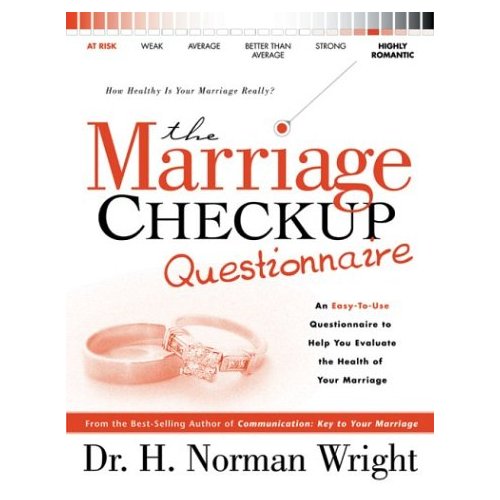
This is a great tool for couples to measure the health of their marriage and discover the areas that need improvement. If you are wondering if marriage counseling would be beneficial check out this resource!`

Monday, November 19, 2007

Marriage Monday

I was home last week and spent some time watching Oprah. She had a couple on the show who had spent the past 40 years writing love letters to each other - every day! Their letters, according to Oprah consisted of three parts:
Part 1: How I feel today."Dear Alton," Patricia wrote after a fight. "I still feel separated from you because of last night.""I feel honored you think I'm a great parent," Alton wrote.
Part 2: "I love you because…""I love you for giving the children their baths," Patricia wrote."I love you for fixin' my supper plate tonight," Alton wrote. "It was good."
Part 3: A question of the day.Alton says these questions could be, "How do I feel when you're sick? How do I feel when you're short with the children? How do I feel when you do something special for me?"

I wondered how this would work for many couples and decided to do some research. Here's an article from Marriage Partnership Journal that suggests something similar. Penning a Marriage: The Power of Interactive Journaling. I think anything that gets couples talking is a good thing, and maybe by writing instead of speaking couples can open up without worrying about interruptions, immediate reactions, or being overheard.

Give it a try!

Monday, November 12, 2007

Marriage Monday: Retired Husband Syndrome


According to Wikipedia, Retired Husband Syndrome (RHS) is a psychosomatic, stress related illness which has been estimated to occur in 60% of Japan's older female population. It is a condition where a woman begins to exhibit signs of physical illness and depression as their husband reaches, or approaches, retirement.


"Retired husband syndrome" is one of the leading causes of divorce among older couples in Japan. The symptoms include irritability, ulcers, rashes, and the recurring urge to toss one's husband out the window.


OK, so living with a retired husband isn't that bad, but it is an adjustment. To be honest I'm sleeping better because he doesn't wake me up getting ready for work at 6 a.m., and it is kind of nice to come home from work to find him doing the laundry or cooking, but there are trade offs!


We have spent the past 33 years seeing each others only evenings, weekends and vacations. Now we spend every hour that I'm not working together. I'm sure that he is adjusting too...his identity for 33 years has been in his job, but until we start building our new house in the spring he doesn't have a lot to do.


As much as we look forward to retiring, retirement can be one of the most stressful events in life. There are a lot of losses in the transition from working to retirement – the loss of routine, work, income and identity. Unfortunately most of us only plan on our financial needs, not our emotional ones as we move into the next phase of life.


If you are approaching retirement age, there are a number of things you can do to prepare for an emotionally healthy retirement, states Elizabeth Holtzman in her seminar on The Emotional Aspects of Retirement:


  • First, begin by talking to someone – spouse, significant other, children, or all of the above about how you feel regarding the impending change in your life. Look at all the aspects, but particularly the emotional part.

  • Begin now to think about what you are passionate about. Is it politics, sports, finance, art or music? Many possibilities are available, but you need to focus on what excites you.

  • Get an emotional checkup. Many couples consult a marriage therapist before taking the big step. In a similar perspective, retirees may want to talk to a therapist about their situation and gain insights.

  • Don’t make other big decisions during this transition time. For example, people who retire and immediately move to another state may wind up suffering two major losses -- the loss of their work-related identity, and the loss of their relationship network.

Achieving a successful retirement is a process that takes planning, time, and experimentation. Retirees who achieve emotional integration learn to know themselves and what will make the coming years satisfying. They are confident in their ability to cope, and they can appreciate the possibilities within themselves. Retirement can then become a passage to new opportunity and self-fulfillment.

Monday, October 22, 2007

Marriage Monday


Community Marriage Policies Help Lower Divorce Rates

ABC News and Charles Gibson had a report on last night about Marriage Savers. You can check out the story at ABC News: Anti-Divorce Effort Saves Marriages. You can check out Marriage Savers here.

Monday, October 15, 2007

Marriage Monday: Divorce Busting

Successful marriages don’t just happen...we should think of marriage like a garden. Successful marriages require regular attention: fertilizing, watering, and weeding. Divorce doesn't just happen either. Marriages, like gardens, don’t die suddenly. Unfortunately they fade away from a gradual lack of attentiveness, taking each other for granted, not spending enough time together.

How can you keep your marriage growing? There are hundreds of web sites devoted to marriage. Here is one that I often refer marriage counseling clients to...


Check out the stages of marriage here.

Monday, October 8, 2007

Marriage Monday: Expectations

"Love is what enables us to bridge the gap of disappointment when others don't live up to the expectations we have of them."
Abigail Van Buren


I went to a friends house last week and noticed that she did something wrong. Her toilet paper roll was facing the wrong direction. You're supposed to put the toilet paper on the roll so the paper comes from the top, not the bottom. Aren't you?! Okay, so I realize that just because she did it different it is not necessarily wrong, but it is not how I do it. It is funny that we expect that people are going to do things the same way that we do them...and if they don't...we wonder what is wrong with them! Our expectation that others think the way we do and do things the same way as us are often unrealistic.
The most significant arena where our expectations bump up against reality is in marriage. Unrealistic expectations can destroy relationships. When we have the attitude that the other person is "wrong" or "stupid" for doing things differently we imply that they are not good enough, or smart enough to know better.
Unfortunately we all walk into marriage with a set of expectations about how to operate in the world, and in marriage. Most of our expectations come from our families of origin, or "the way we've always done it." Many times we don't realize when we get married that we have expectations...until we face the disappointment of our expectations not being met. Our expectations may be big or small, but how we handle our disappointments and differences can make a world of difference in the state of our marriage.

Here are a few areas in which couples struggle with differences and expectations...this list is not exhaustive...I'm sure you can think of more from your own marriage!

Spending vs. Saving * Holidays * Family Time * Vacations * Fitness * Free Time * Communication Styles * Food Preferences * Hobbies * Shopping * Clothes * Sleep Habits * Children (how many, discipline, etc.) * Decorating * Roles * Cold/Warm Bedroom * Crunchy peanut butter/Creamy peanut butter * Windows open/Air conditioning

Although some of these differences seem silly, they can cause problems when one spouse maintains an attitude of superiority that says "My way is the right way!" So how do we deal with our differences and the inevitable disappointments from unmet expectations?
1. Talk about your expectations. Preferably before the wedding!
2. Compromise. If you can't agree on the perfect vacation take turns planning your yearly getaway.
3. Let go of unrealistic expectations. Whether we have idealized a past relationship or just read too many romance novels, we need to let go of the myth of the perfect spouse.
4. Recognize the difference between hoping for something and demanding something. Conflict arises when we feel that our spouse "owes" us. Our spouses are usually more willing to meet our needs when they feel like they are not being forced to!
5. Exercise patience with your partner’s faults and annoying habits. I often tell my husband that we deserve each other. When he complains about my faults I respond, "If I didn't have these faults, I would be married to a much nicer guy than you!!" He knows that I am kidding, and that it is the truth...for both of us!
6. Don't compare your spouse to other people's spouses -- or your marriage to other marriages. I often have people tell me in counseling sessions that they are "jealous" of the couples they see sitting in church or walking through the grocery store together. You don't know what goes on behind closed doors in those marriages. It is not a fair comparison to compare your inside with their outside!
7. Let Philippians 2:3-4 govern your attitude about your marriage and expectations:

Do nothing from selfish or empty conceit, but with humility of mind let each of you regard one another as more important than himself; do not merely look for your own personal interests, but also for the interests of others.